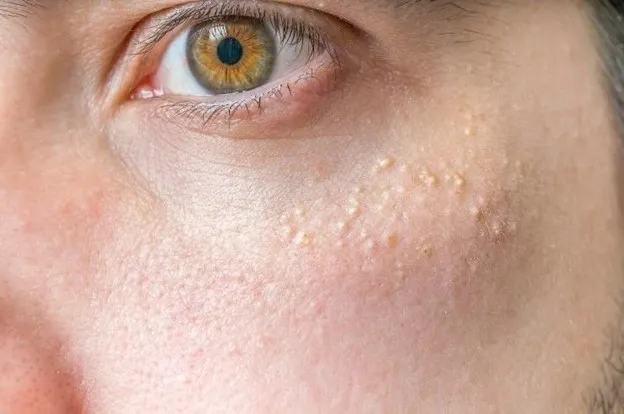
People know how to look for the telltale signs of acne. However, you might notice small, regular bumps found interspersed on your face. These bumps are neither red nor painful, so you probably won’t associate them with acne. Chances are these bumps are milia — small cysts that cause the skin to look slightly coarse.
Types of Milia
Milia come in five different types — neonatal, primary, traumatic, milia en plaque, and multiple eruptive milia.
As the name suggests, neonatal milia affect newborns. Small bumps are often present from birth. You might find them on the scalp, upper body, inside the mouth, and, especially, the nose and other areas of the face. They differ from neonatal acne in that they’re uniform in size and unaccompanied by redness.
Traumatic milia occur after some damage to the skin clogs the sweat ducts. Trauma is usually a type of burn, either from touch or from the sun, or blisters that occur because of an allergic reaction. In some rare cases, laser resurfacing or dermabrasion can cause them.
Two types of milia occur in clusters. One is the rare condition called milia en plaque, which presents as broad, flat patches raised above the rest of the skin. Multiple eruptive milia are also rare and also present in clusters. However, this type of milia isn’t raised into a flat patch.
The most common form of milia is primary, which can affect any age. You find this type on the eyelids, cheeks, forehead, and even genitals. Primary milia sometimes disappear on their own.
Causes of Milia
Milia form when flakes of keratin become trapped under the skin. Keratin is one of the building-block proteins of your skin. Keratin helps form the rigidity of your skin, and it’s tasked with offering a barrier of protection. So, when this strong protein becomes trapped within a pore, it creates a pearly bump — the milium.
Milia occurs when the skin for some reason can’t expel the tiny flakes of keratin. In the case of adults, the reason is usually that overexposure to the sun has made the skin leathery. As a result, the skin has difficulty expelling the keratin flakes to the surface. Because blistering also prevents the natural exfoliation of the skin, such injuries can also result in the formation of milia.
Home Removal of Milia
Mild cases of milia usually go away on their own. However, you can try a few home procedures that won’t damage your skin and might hasten their departure. A good home remedy is to steam your face. You can do this in the bathroom as part of a hot shower, or you can purchase a facial steamer. The steam opens the pores and helps the pores expel the keratin flakes.
You can also use exfoliating cleansers that contain salicylic acid or glycolic acid. These exfoliants help the skin expel the excess keratin. Those acids along with citric acid help prevent the skin from overproducing keratin in the first place.
Across the board, dermatologists caution against picking or squeezing the milia. You can’t relieve the pores of their keratin flakes that way. The only result will be red, traumatized skin. You might even incur scaring.
Medical Removal of Milia
If the milia persist, or if they are really bothersome, your best bet is to turn to a dermatologist. They have the best tools and procedures for eliminating these tiny cysts.
The most common procedure for milia removal is de-roofing. Dermatologists use a sterile needle to remove the tiny flap of skin trapping the keratin flake inside the pore. They then squeeze or prick out the flake.
A less-common practice is a curettage, which is a form of electrosurgery. With this procedure, the dermatologist scrapes off the milia and then seals the skin with a hot wire. A similarly uncommon procedure is cryotherapy, in which the dermatologist freezes off the milia with liquid nitrogen.
If you have persistent milia, consider making an appointment with your dermatologist to have them removed. Call Advanced Dermatology & Skin Cancer Specialists for any of your skin concerns.